MeshShader Struct Reference
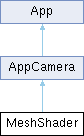
Inheritance diagram for MeshShader:
Public Member Functions | |
| MeshShader (const char *filename) | |
| int | init () |
| a deriver pour creer les objets openGL. renvoie -1 pour indiquer une erreur, 0 sinon. | |
| int | quit () |
| a deriver pour detruire les objets openGL. renvoie -1 pour indiquer une erreur, 0 sinon. | |
| int | render () |
| a deriver pour afficher les objets. renvoie 1 pour continuer, 0 pour fermer l'application. | |
| Public Member Functions inherited from AppCamera | |
| AppCamera (const int width, const int height, const int major=3, const int minor=3) | |
| constructeur, dimensions de la fenetre et version d'openGL. | |
| virtual int | update (const float time, const float delta) |
| a deriver et redefinir pour animer les objets en fonction du temps. | |
| const Orbiter & | camera () const |
| renvoie l'orbiter gere par l'application. | |
| Orbiter & | camera () |
| renvoie l'orbiter gere par l'application. | |
| Public Member Functions inherited from App | |
| App (const int width, const int height, const int major=3, const int minor=3) | |
| constructeur, dimensions de la fenetre et version d'openGL. | |
| int | run () |
| execution de l'application. | |
Protected Attributes | |
| Mesh | m_mesh |
| GLuint | m_program |
| GLuint | m_program_display |
| GLuint | vertex_buffer |
| GLuint | cluster_buffer |
| GLuint | vao |
| Protected Attributes inherited from AppCamera | |
| Orbiter | m_camera |
| Protected Attributes inherited from App | |
| Window | m_window |
| Context | m_context |
| bool | sync |
Additional Inherited Members | |
| Protected Member Functions inherited from AppCamera | |
| int | prerender () |
| Protected Member Functions inherited from App | |
| virtual int | postrender () |
| void | vsync_off () |
Detailed Description
Definition at line 28 of file tuto_mesh_shader.cpp.
Constructor & Destructor Documentation
◆ MeshShader()
|
inline |
Definition at line 30 of file tuto_mesh_shader.cpp.
30 : AppCamera( 1024, 640, 4,6 )
31 {
32 {
33 if(!GLAD_GL_EXT_mesh_shader)
34 {
36 exit(1);
37 }
38
40
41 GLboolean flag;
42 glGetBooleanv(GL_MESH_PREFERS_LOCAL_INVOCATION_VERTEX_OUTPUT_EXT, &flag);
43 if(flag) printf(" prefers local invocation vertex output\n"); else printf(" [no] prefers local invocation vertex output\n");
44 glGetBooleanv(GL_MESH_PREFERS_LOCAL_INVOCATION_PRIMITIVE_OUTPUT_EXT, &flag);
45 if(flag) printf(" prefers local invocation primitive output\n"); else printf(" [no] prefers local invocation primitive output\n");
46 glGetBooleanv(GL_MESH_PREFERS_COMPACT_VERTEX_OUTPUT_EXT, &flag);
47 if(flag) printf(" prefers compact vertex output\n"); else printf(" [no] prefers compact vertex output\n");
48 glGetBooleanv(GL_MESH_PREFERS_COMPACT_PRIMITIVE_OUTPUT_EXT, &flag);
49 if(flag) printf(" prefers compact primitive output\n"); else printf(" [no] prefers compact primitive output\n");
50
51 GLint n;
52 glGetIntegerv(GL_MAX_PREFERRED_TASK_WORK_GROUP_INVOCATIONS_EXT, &n);
54 glGetIntegerv(GL_MAX_PREFERRED_MESH_WORK_GROUP_INVOCATIONS_EXT, &n);
56
57 glGetIntegerv(GL_MAX_MESH_OUTPUT_VERTICES_EXT, &n);
59 glGetIntegerv(GL_MAX_MESH_OUTPUT_PRIMITIVES_EXT, &n);
61 glGetIntegerv(GL_MAX_MESH_OUTPUT_COMPONENTS_EXT, &n);
63 glGetIntegerv(GL_MAX_MESH_OUTPUT_LAYERS_EXT, &n);
65 }
66
67 m_mesh= read_indexed_mesh_fast(filename);
68 }
AppCamera(const int width, const int height, const int major=3, const int minor=3)
constructeur, dimensions de la fenetre et version d'openGL.
Definition app_camera.cpp:5
void printf(Text &text, const int px, const int py, const char *format,...)
affiche un texte a la position x, y. meme utilisation que printf().
Definition text.cpp:140
Mesh read_indexed_mesh_fast(const char *filename)
charge un fichier wavefront .obj et renvoie un mesh compose de triangles indexes. utiliser glDrawElem...
Definition wavefront_fast.cpp:329
Member Function Documentation
◆ init()
|
inlinevirtual |
a deriver pour creer les objets openGL. renvoie -1 pour indiquer une erreur, 0 sinon.
Implements AppCamera.
Definition at line 70 of file tuto_mesh_shader.cpp.
71 {
72 if(m_mesh.vertex_count() == 0)
73 return 0; // pas de mesh, pas de tuto...
74
75 // mesh
76 const std::vector<vec3>& positions= m_mesh.positions();
77 std::vector<unsigned> indices= m_mesh.indices(); // copie les indices pour les modifier...
78
79 // re-indexation des sommets uniques
80 std::map<vec3, unsigned, vec3_less> vertex;
81 std::vector<unsigned> remap( indices.size() );
82 for(unsigned i= 0; i < positions.size(); i++)
83 {
84 auto v= vertex.insert( { positions[i], i } );
85 remap[i]= v.first->second;
86 }
87
88 for(unsigned i= 0; i < indices.size(); i++)
89 indices[i]= remap[ indices[i] ];
90
92
93 // construit les groupes de triangles
94 std::set<unsigned> cluster;
95 std::vector<unsigned> cluster_id(indices.size(), -1);
96 std::vector<unsigned> triangle_id;
97 triangle_id.reserve(indices.size()/3);
98
99 unsigned id= 0;
100 for(unsigned i= 0; i < indices.size(); i++)
101 //~ for(unsigned i= 0; i +2< indices.size(); i+= 3)
102 {
103 unsigned a= indices[i];
104 cluster.insert(a);
105 //~ unsigned b= indices[i+1];
106 //~ cluster.insert(b);
107 //~ unsigned c= indices[i+2];
108 //~ cluster.insert(c);
109
110 if(cluster.size() >= 32)
111 {
112 id++;
113 cluster.clear();
114 }
115
116 triangle_id.push_back(id);
117 }
118 unsigned count= id+1;
119 cluster.clear();
120
121 // couleurs aleatoires
122 std::vector<vec3> colors( count );
123
124 std::random_device hwseed;
125 std::default_random_engine rng( hwseed() );
126 std::uniform_real_distribution<float> uniform;
127
128 for(unsigned i= 0; i < colors.size(); i++)
129 colors[i]= { uniform(rng), uniform(rng), uniform(rng) };
130
131 // affecte une couleur a chaque triangle
132 std::vector<vec3> vertex_colors;
133 std::vector<vec3> vertex_positions;
134 vertex_colors.reserve( indices.size() );
135 vertex_positions.reserve( indices.size() );
136 for(unsigned i= 0; i +2 < indices.size(); i+= 3)
137 {
138 unsigned a= indices[i];
139 unsigned b= indices[i+1];
140 unsigned c= indices[i+2];
141
142 vertex_positions.push_back( positions[ a ] );
143 vertex_positions.push_back( positions[ b ] );
144 vertex_positions.push_back( positions[ c ] );
145
146 vertex_colors.push_back( colors[ triangle_id[i/3] ] );
147 vertex_colors.push_back( colors[ triangle_id[i/3] ] );
148 vertex_colors.push_back( colors[ triangle_id[i/3] ] );
149 }
150
151 glGenVertexArrays(1, &vao);
152 glBindVertexArray(vao);
153
154 glGenBuffers(1, &vertex_buffer);
155 glBindBuffer(GL_ARRAY_BUFFER, vertex_buffer);
156 glBufferData(GL_ARRAY_BUFFER, vertex_positions.size() * sizeof(vec3), vertex_positions.data(), GL_STATIC_DRAW);
157 glVertexAttribPointer(0, 3, GL_FLOAT, GL_FALSE, 0, 0);
158 glEnableVertexAttribArray(0);
159
160 glGenBuffers(1, &cluster_buffer);
161 glBindBuffer(GL_ARRAY_BUFFER, cluster_buffer);
162 glBufferData(GL_ARRAY_BUFFER, vertex_colors.size() * sizeof(vec3), vertex_colors.data(), GL_STATIC_DRAW);
163 glVertexAttribPointer(1, 3, GL_FLOAT, GL_FALSE, 0, 0);
164 glEnableVertexAttribArray(1);
165
166 //
167 Point pmin, pmax;
168 m_mesh.bounds(pmin, pmax);
170
171 //
173 program_print_errors(m_program);
174
176 program_print_errors(m_program_display);
177
178 // etat openGL par defaut
179 glClearColor(0.2f, 0.2f, 0.2f, 1.f); // couleur par defaut de la fenetre
180
181 glClearDepth(1.f); // profondeur par defaut
182 glDepthFunc(GL_LESS); // ztest, conserver l'intersection la plus proche de la camera
183 glEnable(GL_DEPTH_TEST); // activer le ztest
184
185 glFrontFace(GL_CCW);
186 glCullFace(GL_BACK);
187 //~ glEnable(GL_CULL_FACE);
188
189 return 1;
190 }
void lookat(const Point ¢er, const float size)
observe le point center a une distance size.
Definition orbiter.cpp:7
GLuint read_program(const char *filename, const char *definitions)
Definition program.cpp:214
int program_print_errors(const GLuint program, const char *filename)
affiche les erreurs de compilation.
Definition program.cpp:459
◆ quit()
|
inlinevirtual |
a deriver pour detruire les objets openGL. renvoie -1 pour indiquer une erreur, 0 sinon.
Implements AppCamera.
Definition at line 192 of file tuto_mesh_shader.cpp.
193 {
194 return 0;
195 }
◆ render()
|
inlinevirtual |
a deriver pour afficher les objets. renvoie 1 pour continuer, 0 pour fermer l'application.
Implements AppCamera.
Definition at line 197 of file tuto_mesh_shader.cpp.
198 {
200 {
202 reload_program(m_program);
203 program_print_errors(m_program);
204
205 reload_program(m_program_display);
206 program_print_errors(m_program_display);
207 }
208
210 glClear(GL_COLOR_BUFFER_BIT | GL_DEPTH_BUFFER_BIT);
211
212 Transform model;
213 //~ Transform model= RotationZ(global_time() / 100);
216
217 Transform mvp= projection * view * model;
218
219#if 1
220 glBindVertexArray(vao);
221 glUseProgram(m_program_display);
222 program_uniform(m_program_display, "mvpMatrix", mvp);
223
224 glDrawArrays(GL_TRIANGLES, 0, m_mesh.index_count());
225#else
226
228
229 glBindVertexArray(0);
230 glUseProgram(m_program);
231 program_uniform(m_program, "color", Color(r,0,0));
232 program_uniform(m_program, "mvpMatrix", mvp);
233
234 glDrawMeshTasksEXT(1, 1, 1);
235#endif
236
237 return 1;
238 }
Transform projection(const int width, const int height, const float fov)
fixe la projection reglee pour une image d'aspect width / height, et une demi ouverture de fov degres...
Definition orbiter.cpp:48
int key_state(const SDL_Keycode key)
renvoie l'etat d'une touche du clavier. cf la doc SDL2 pour les codes.
Definition window.cpp:63
float global_time()
renvoie le temps ecoule depuis le lancement de l'application, en millisecondes.
Definition window.cpp:145
Member Data Documentation
◆ m_mesh
|
protected |
Definition at line 241 of file tuto_mesh_shader.cpp.
◆ m_program
|
protected |
Definition at line 242 of file tuto_mesh_shader.cpp.
◆ m_program_display
|
protected |
Definition at line 243 of file tuto_mesh_shader.cpp.
◆ vertex_buffer
|
protected |
Definition at line 245 of file tuto_mesh_shader.cpp.
◆ cluster_buffer
|
protected |
Definition at line 246 of file tuto_mesh_shader.cpp.
◆ vao
|
protected |
Definition at line 247 of file tuto_mesh_shader.cpp.
The documentation for this struct was generated from the following file:
- gkit2_tutos/M2/tuto_mesh_shader.cpp
Generated on for gKit2 light by
 1.17.0