Théorie de l’aile
Marc BUFFAT département mécanique, Lyon 1
%matplotlib inline
import numpy as np
import sympy as sp
import matplotlib.pyplot as plt
from metakernel import register_ipython_magics
register_ipython_magics()Théorie de la portance
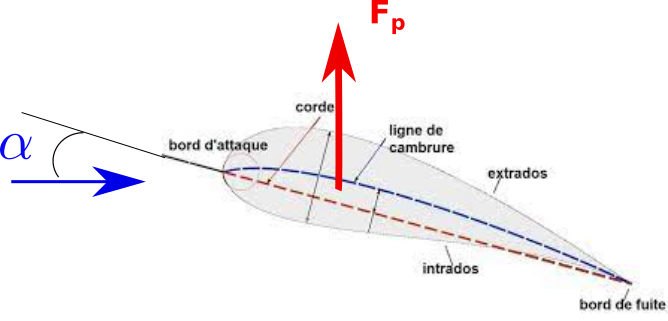
les différentes théories de la portance (sur internet):
Appuie de l’aile sur l’air (principe de réaction de Newton)
Bernoulli + égalité des temps de parcours
Analyse globale: bilan de quantité de mouvement, déviation de l’écoulement
Théorie de la Circulation de vitesse
#%activity /usr/local/commun/ACTIVITY/MGC3062L/portanceUsageError: Line magic function `%activity` not found.
Caractéristique aérodynamique d’un profil
Analyse dimensionnelle:
Etude d’un profil 2D
étude en fonction de l’angle
fonction du nombre de Reynolds
coefficiant de portance: projection suivant à
coefficient de moment (moment pression) par rapport à un point de référence , qui n’est donc pas nécessairement sur la ligne moyenne à 1/4 de corde
on calcule alors le moment en un point Q quelconque par la relation de transport
d’où la position du centre de poussée exacte / à (erreur)
Analyse par bilan de quantité de mouvement
Modèle simplifié des efforts exercés par un profil d’aile de longueur (de corde) en incidence d’angle sur un écoulement stationnaire d’un fluide parfait incompressible de masse volumique et de vitesse (schéma ci-dessous)
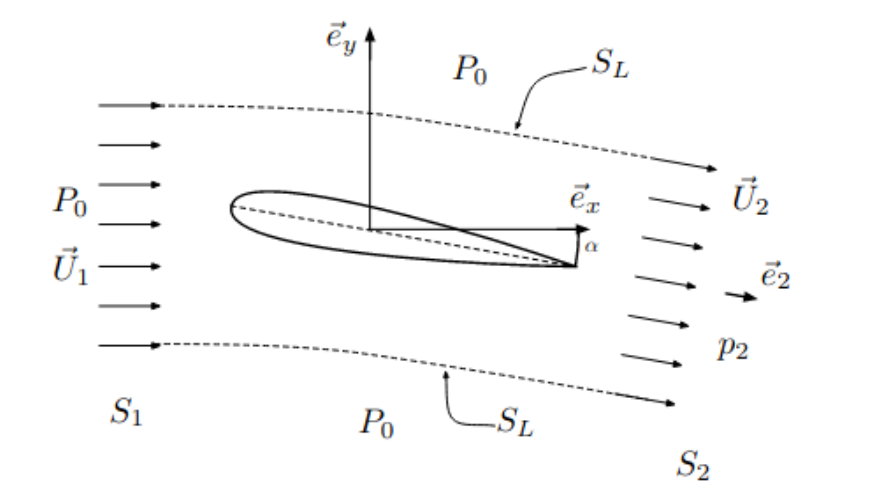
On constate expérimentalement que l’effet de l’aile sur l’écoulement, aux faibles incidences, est de dévier les lignes de courant d’un angle correspondant à l’angle d’incidence du profil, c.a.d l’angle d’inclinaison du bord de fuite.
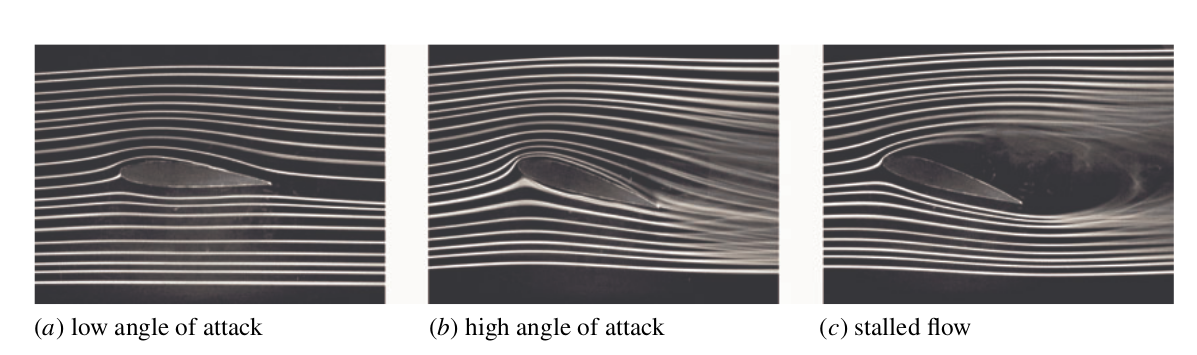
d’après “How do wings work?” H. Babinsky, Physics Education 38(6) 2003
A 1-minute video released by the University of Cambridge sets the record straight on a much misunderstood concept - how wings lift. I start by giving the wrong explanation and asking who has heard it and every time 95% of the audience puts their hand up. Only a handful will know that it is wrong.Professor Holger BabinskyIt’s one of the most tenacious myths in physics and it frustrates aerodynamicists the world over. Now, …
from IPython.display import YouTubeVideo

YouTubeVideo('e0l31p6RIaY', width=600, height=400)bilan de masse et de quantité de mouvement
on en déduit par bilan de quantité de mouvement la force de portance et le coefficient de portance
soit à faible incidence une proportionnalité du coefficient de portance avec l’angle d’incidence
Potentiel complexe
Pour un écoulement incompressible 2D de fluide parfait irrotationnel le potentiel et la fonction de courant vérifie l’éuqtaion de Laplace:
dont le champ de vitesse en cartésien est donné par
On définit alors un potentiel complexe :
qui est une fonction analytique en z, dont la dérivée est indépendante de dz.
Dans ce cas est différentiable en z et vérifie:
On le vérifie en prenant respectivement et et en utilisant les relations de Cauchy-Riemann entre et
On en déduit le module de la vitesse:
et son angle
Coordonnées polaires
En coordonnées polaires, l’équation de Laplace s’écrit:
et le champ de vitesse en polaire
soit en coordonnées cartésiennes
Potentiel complexe en polaire
puisque on a donc :
avec
On en déduit aussi
Potentiel complexe de l’écoulement autour d’un cylindre
On a vu que l’écoulement potentiel autour d’un cylindre de rayon en rotation est la somme d’un écoulement uniforme, d’un doublet et d’un vortex de circulation
Pour une vitesse d’incidence , le potentiel complexe s’écrit
et la vitesse complexe
# parametres
R, U0 = sp.symbols('R U_0',real=True, positive=True)
Gamma,alpha = sp.symbols('Gamma alpha',real=True)
# variables
theta,x,y = sp.symbols('theta x y',real=True)
r         = sp.symbols('r',real=True,Positive=True)
# fonctions pour manipuler les complexes
from sympy import re,im,I
Pour une vitesse d’incidence , le potentiel complexe s’écrit
# potentiel complexe Phi
z = sp.symbols('z')
Phi = U0*z*sp.exp(-I*alpha) + U0*sp.exp(I*alpha)*R**2/z \
    - (I*Gamma/(2*sp.pi))*sp.log(z*sp.exp(-I*alpha)/R)
display("Phi(z)=",Phi)'Phi(z)='la vitesse complexe est alors donnée par
# calcul de la vitesse complexe W
W = 0
### BEGIN SOLUTION
W = sp.diff(Phi,z)
### END SOLUTION
display("W(z)=",W)'W(z)='# calcul fonction de courant psi (en fonction de (x,y)
psi = 0
### BEGIN SOLUTION
psi = im(Phi.subs(z,x+sp.I*y))
### END SOLUTION
display('psi(x,y)=',psi)'psi(x,y)='# en déduire les composantes de vitesse dans Ux et Uy
Ux = 0
Uy = 0
### BEGIN SOLUTION
Ux = re(W.subs(z,x+sp.I*y))
Uy = -im(W.subs(z,x+sp.I*y))
### END SOLUTION
display("Ux=",Ux)
display("Uy=",Uy)'Ux=''Uy='Visualisation des champs
utilisation d’une technique de masque pour éliminer l’écoulement à l’intérieur du cercle
# parametres numeriques: choix arbitraire de Gamma et alpha !
R0   = 0.5
Uinf = 1.0
vals = [(Gamma,-2*np.pi*R*U0),(alpha,np.deg2rad(10)),(R,R0),(U0,Uinf)]
display("parametres:",vals)
'parametres:'[(Gamma, -6.28318530717959*R*U_0),
(alpha, 0.17453292519943295),
(R, 0.5),
(U_0, 1.0)]# domaine de calcul et maillage (grille) pour le calcul de psi et de la vitesse
L = 3
N = 201
pas = 8 # pas pour les vitesses
# points de calcul
xg = np.linspace(-L,L,N)
yg = np.linspace(-L/2,L/2,N)
# pour les lignes de courant psi
X, Y = np.meshgrid(xg, yg)
# utilisation d'un masque
Z = X + 1j*Y
Z = np.ma.masked_where(np.absolute(Z)<0.95*R0,Z)
X = Z.real
Y = Z.imag
# et le champ de vitesse U
XX = X[::pas,::pas]
YY = Y[::pas,::pas]# calcul des valeurs numeriques
psi1 = sp.lambdify([x,y],psi.subs(vals),'numpy')
u1 = sp.lambdify([x,y],Ux.subs(vals),'numpy')
v1 = sp.lambdify([x,y],Uy.subs(vals),'numpy')
with np.errstate(divide='ignore'):
Psi1 = psi1(X,Y)
Psi0 = psi1(0.5,0)
Levs = np.linspace(Psi0-L/5,Psi0+L/5,21)
U1 = u1(XX,YY)
V1 = v1(XX,YY)<lambdifygenerated-1>:2: RuntimeWarning: invalid value encountered in sqrt
return -0.17364817766693*x + 0.984807753012208*y + 1.5707963267949*log(2.0*sqrt(x**2 + y**2))/pi + 0.25*imag(exp(0.174532925199433*1j)/(x + 1j*y))
# tracer
fig, ax = plt.subplots(figsize=(12,6))
#ax.contourf(X,Y,Psi1,levels=21)
ax.contour(X,Y, Psi1,levels=Levs,colors='r')
ax.quiver(XX,YY,U1,V1)
cercle = plt.Circle((0.,0.),R0,color='yellow')
ax.add_artist(cercle)
plt.axis('equal')
plt.axis('off')
plt.title("Ecoulement autour du cylindre");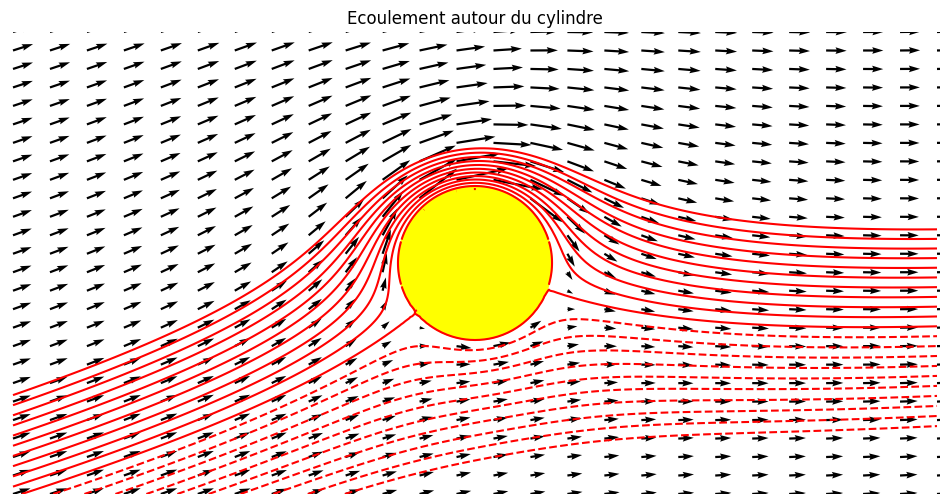
Transformation conforme
On définit une transformation conforme qui préserve les angles dans le plan complexe.
Transformation de Joukovski
avec (plan d’origine) et (plan transformé)
C = sp.symbols('C',real=True,positive=True)
F = lambda z: z + C**2/z
display("Z=F(z)",F(z))'Z=F(z)'transformation conforme
transformation de l’écoulement autour d’un cercle de centre de rayon
paramétre de la transformation
angle du point centre / horizontal
# selection cas 1,2,3,4 (choix 4 par defaut)
cas  = 4
beta = 0
if cas==0:
    # cercle
    x0 = 0
    y0 = 0
    R0 = float(R.subs(vals))
    c  = float(R.subs(vals)*0.0)
elif cas==1:
    # parametres pour une ellipse
    x0 = 0
    y0 = 0
    R0 = float(R.subs(vals))
    c  = float(R.subs(vals)*0.9)
elif cas==2:
    # parametre pour une plaque
    x0 = 0
    y0 = 0
    R0 = float(R.subs(vals))
    c  = float(R.subs(vals)*1.0)
elif cas==3:
    # parametres pour un profil symetrique
    R0 = float(R.subs(vals))
    c  = float(R.subs(vals)/1.2)
    x0 = c - R0
    y0 = 0
else:
    # parametres pour un profil cambre
    beta = np.deg2rad(8)
    R0 = float(R.subs(vals))
    c  = float(R.subs(vals)/1.2)
    x0 = c - R0*np.cos(beta)
    y0 = R0*np.sin(beta)
# calcul de la transformation en coordonnées cartésienne
xc = re(F(x+sp.I*y))
yc = im(F(x+sp.I*y))
display("xc,yc=",xc,yc)'xc,yc='# transformation du cercle
Xc = sp.lambdify([x,y],xc.subs(C,c),'numpy')
Yc = sp.lambdify([x,y],yc.subs(C,c),'numpy')
Theta = np.linspace(0,2*np.pi,410)
XC = Xc(x0+R0*np.cos(Theta),y0+R0*np.sin(Theta))
YC = Yc(x0+R0*np.cos(Theta),y0+R0*np.sin(Theta))plt.figure(figsize=(8,6))
plt.plot(XC,YC)
plt.title("Transformation de Joukovski")
plt.axis('equal');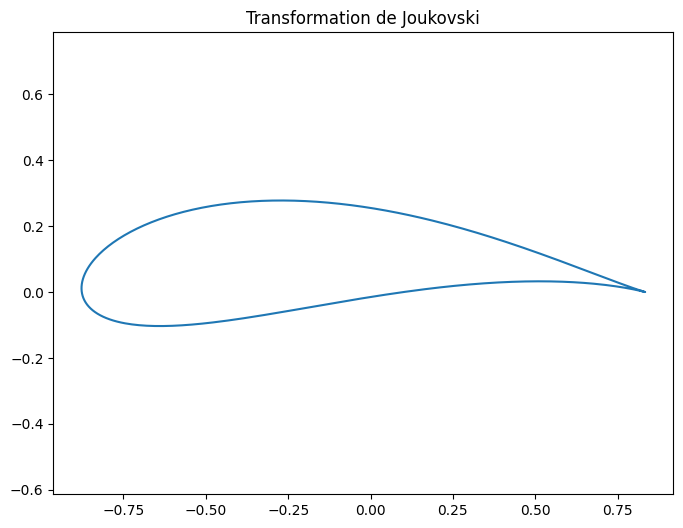
calcul de l’écoulement par transformation de Joukovski
calcul pour un profil
transformation numérique
def TransJ(Z,lam):
    '''transformation Joukovski (complexe)'''
    return Z + lam**2/Z
def Cercle(C0,R):
    '''pts du cercle de centre C0 (complexe) et de rayon R'''
    Theta = np.linspace(0,2*np.pi,200)
    return C0 + R*np.exp(1j*Theta)
def solutionJ(PHI,lam,C0,R,xg,yg):
    '''calcul de la solution par transformation de Joukovski PHI'''
    X,Y  = np.meshgrid(xg,yg)
    Z    = X+1j*Y
    Z    = np.ma.masked_where(np.absolute(Z-C0)<=R,Z)
    Zc   = Z - C0
    #Phiz = PHI(Z)
    # BUG numpy: calcul
    # np.log(Z) cannot be calculated correctly due to a numpy bug np.log(MaskedArray);
    Phiz = Zc.copy()
    with np.errstate(divide='ignore'):
        for m in range(Zc.shape[0]):
            for n in range(Zc.shape[1]):
                Phiz[m,n] = PHI(Zc[m,n])
    # Joukovski transformation
    J  = TransJ(Z, lam)
    cercle = Cercle(C0, R)
    airfoil= TransJ(cercle, lam)
    return J, Phiz.imag, airfoil
#valeur des parametres
display("parametres ",vals)
alpha0 = np.rad2deg(float(alpha.subs(vals)))
print("alpha={} deg. beta={} deg. c={} C0={}".format(alpha0,np.rad2deg(beta),c,x0+1j*y0))'parametres '[(Gamma, -6.28318530717959*R*U_0),
(alpha, 0.17453292519943295),
(R, 0.5),
(U_0, 1.0)]alpha=10.0 deg. beta=8.0 deg. c=0.4166666666666667 C0=(-0.0784673677041185+0.06958655048003272j)
display(Phi)
# calcul du potentiel complexe
PhiJ = Phi.subs(vals)
display("Phi(z)=",PhiJ)
# conversion fonction python
PHI = sp.lambdify(z,PhiJ)'Phi(z)='# calcul solution ! pble mauvaise valeur de la circulation
J, Psi, airfoil = solutionJ(PHI,c,x0+1j*y0,R0,xg,yg)
# tracer
fig=plt.figure(figsize=(12,8))
ax=fig.add_subplot(111)
# this means that the flow is evaluated at Juc(z) since c_flow(Z)=C_flow(csi(Z))
cp=ax.contour(J.real, J.imag, Psi,levels=Levs, colors='blue', linewidths=1,
linestyles='solid')
ax.plot(airfoil.real, airfoil.imag)
ax.fill(airfoil.real, airfoil.imag,color='yellow')
plt.axis('off')
plt.title("Problème: eclt au bord de fuite car circulation non correcte")
ax.set_aspect('equal');
#plt.savefig('eclt_cylindre.png')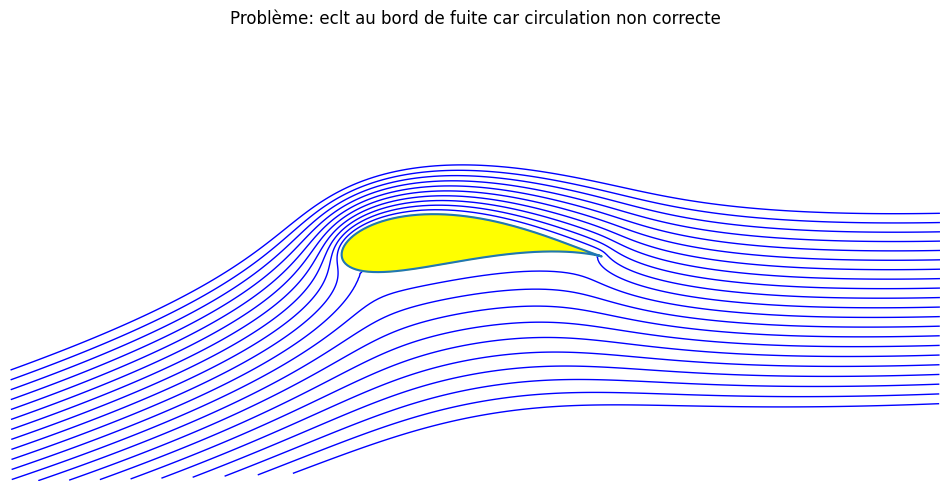
# valeur de Joukovski
GammaJ = -4*sp.pi*U0*R*sp.sin(alpha+beta)
display("GammaJ=",GammaJ)
# potentiel Joukovsky
PhiJ = Phi.subs(Gamma,GammaJ).subs(vals)
display("PhiJ=",PhiJ)
# conversion fonction python
PHI = sp.lambdify(z,PhiJ)'GammaJ=''PhiJ='# calcul solution
J, Psi, airfoil = solutionJ(PHI,c,x0+1j*y0,R0,xg,yg)
# tracer
fig=plt.figure(figsize=(12,8))
ax=fig.add_subplot(111)
# this means that the flow is evaluated at Juc(z) since c_flow(Z)=C_flow(csi(Z))
cp=ax.contour(J.real, J.imag, Psi,levels=Levs, colors='blue', linewidths=1,
linestyles='solid')
ax.plot(airfoil.real, airfoil.imag)
ax.fill(airfoil.real, airfoil.imag,color='yellow')
plt.axis('off')
ax.set_aspect('equal');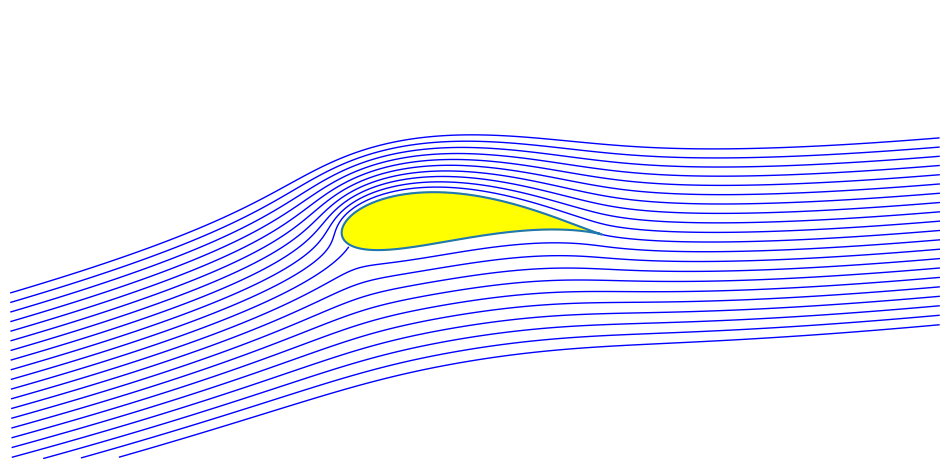
Calcul de la Portance
Condition de Kutta - Joukovsky
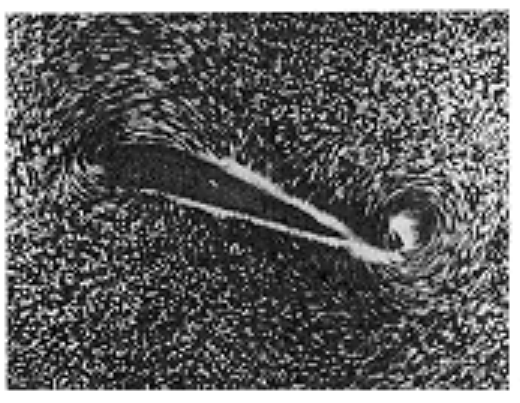
création circulation vitesse telle que la vitesse reste parallèle au bord de fuite (pas de contournement)
condition de kutta-joukovski
circulation
portance
en faible incidence
from IPython.display import YouTubeVideo

YouTubeVideo('VcggiVSf5F8', width=600, height=400)Annexe: Joukovski-airfoil
Ce notebook est inspiré d’un notebook de calcul de l’écoulement autour d’un profil de Joukovski