Ondes de gravité et surface libre
Marc BUFFAT, département mécanique Lyon 1

%matplotlib inline
import numpy as np
import scipy as sp
import matplotlib.pyplot as plt
from IPython.core.display import HTML
import matplotlib.animation as animation
from matplotlib import rc
from metakernel import register_ipython_magics
register_ipython_magics()
from IPython.display import YouTubeVideo
YouTubeVideo('MNyebpog_i0', width=600, height=400)Loading...
Equation des ondes de surface
soit la variation de la hauteur d’eau dans un bassin de longueur et la perturbation de vitesse horizontale. Les équations de SAint Venant linéarisées s’écrivent:
bilan de masse:
bilan de qte mouvement horizontal
Il peut se développer des ondes de surface dans un bassin de longueur L, solution de l’équation des ondes:
avec des conditions aux limites :
solution élémentaire: onde stationnaire
solution générale
paramètres
g gravité
h0 hauteur d’eau
a0 amplitude perturbation
L longueur bassin
Influences des paramètres sur le mouvement des ondes ?
# parametres
g=10.0
h0=1.
a0=0.1
c0=np.sqrt(g*h0)
L =20.
Np=128
X=np.linspace(0,L,Np,endpoint=False)
print("parametres célérité= {:.2f}m/s   h0/L={:.3f}  a0/h0={:.3f}".format(c0,h0/L,a0/h0))
parametres célérité= 3.16m/s h0/L=0.050 a0/h0=0.100
solution élémentaire: onde stationnaire
# solution elementaire CL de tye Neuman
def hk(k,x,t):
    global c0,L
    return np.cos(k*np.pi*x/L)*np.cos(k*np.pi*c0*t/L)
# solutions elementaires
plt.rc('font', family='serif', size='18')
plt.figure(figsize=(12,4))
plt.plot(X,hk(1,X,0),label="k=1")
plt.plot(X,hk(2,X,0),label="k=2")
plt.plot(X,hk(3,X,0),label="k=3")
plt.plot(X,hk(16,X,0),label="k=16")
plt.plot(X,np.zeros(X.size),'-k',lw=2)
plt.legend()
plt.title("Solutions élémentaires")
plt.xlabel('x')
plt.ylabel('h');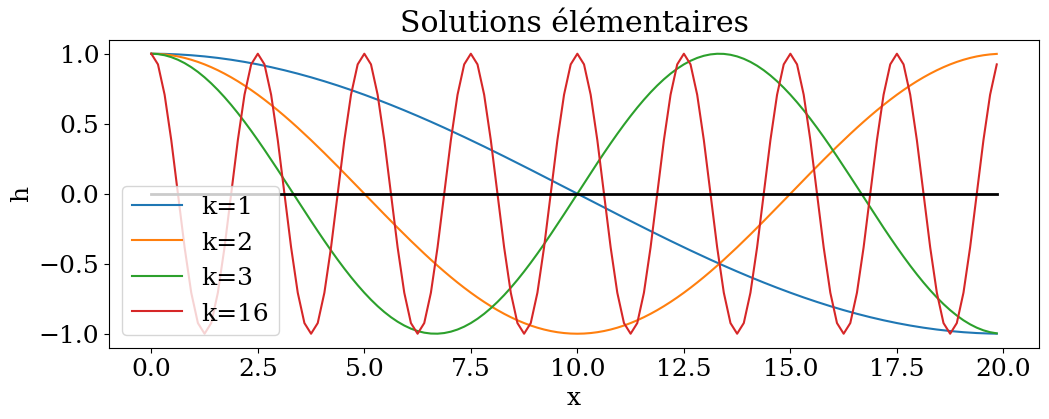
#%activity /usr/local/commun/ACTIVITY/MGC3062L/questionOndeStationnaireanimation
# choix du mode
mode=8
#
periode=2*L/(mode*c0)
t=np.linspace(0,2*periode,41)
fig = plt.figure(figsize=(10,4))
ax  = plt.axes()
line, = ax.plot([], [],linewidth=2)
plt.axis((0,L,-1.,0.5))
plt.title("ondes stationnaire mode={}".format(mode))
plt.xlabel('x')
plt.ylabel('h(x,t)')
def plot_mode(t):
    Y = a0*hk(mode,X,t)
    line.set_data(X,Y)

anim=animation.FuncAnimation(fig, plot_mode, frames=t)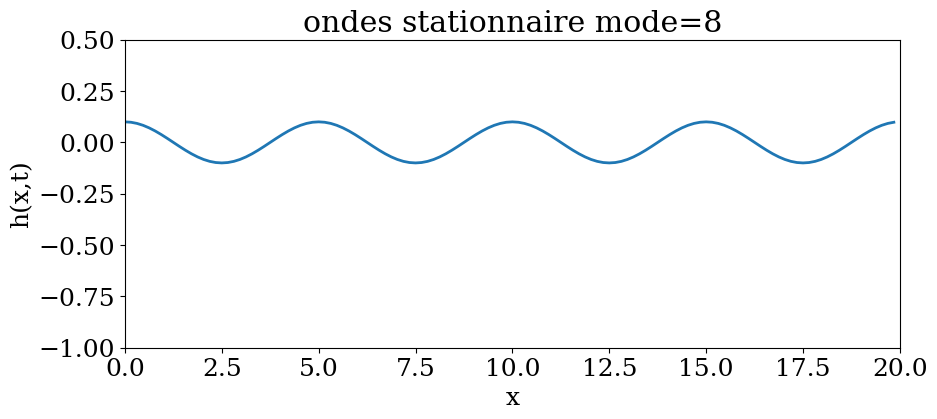
rc('animation', html='jshtml')
anim
Loading...
def uk(k,x,t):
    global c0,L,g
    return (g/c0)*np.sin(k*np.pi*x/L)*np.sin(k*np.pi*c0*t/L)
mode=2
plt.figure(figsize=(12,4))
plt.plot(X,a0*uk(mode,X,2),label="u(x,t)")
plt.plot(X,a0*hk(mode,X,2),label="h(x,t)")
plt.plot(X,np.zeros(X.size),'-k',lw=2)
plt.legend()
plt.title("vitesse et hauteur mode {}".format(mode))
plt.xlabel('x')
plt.ylabel('h');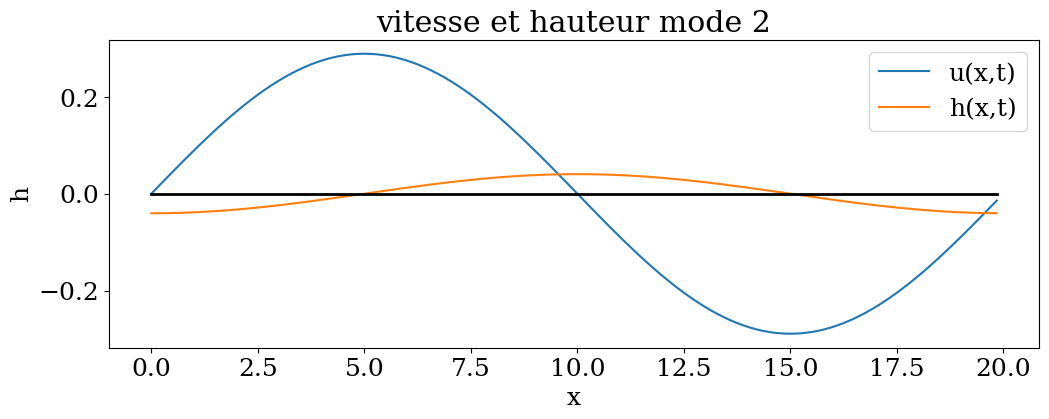
Animation
mode = 2
periode=2*L/(mode*c0)
t=np.linspace(0,2*periode,41)
XP = np.linspace(0,L,11)
YP = -0.25*np.ones(XP.size)
UP = a0*uk(mode,XP,0)+1.e-3
VP = np.zeros(UP.size)
fig = plt.figure(figsize=(12,4))
ax  = plt.axes()
plt.axis((0,L,-1.,0.5))
Q   = ax.quiver(XP,YP,UP,VP,scale_units='xy',scale=0.1)
Line, = plt.plot(X,a0*hk(mode,X,2),label="h(x,t)")
plt.title("vitesse et hauteur mode {}".format(mode))
def plot_mode(t):
    Y  = a0*hk(mode,X,t)
    Line.set_data(X,Y)
    UP = a0*uk(mode,XP,t)+1.e-3
    Q.set_UVC(UP,VP)
#
anim=animation.FuncAnimation(fig, plot_mode, frames=t)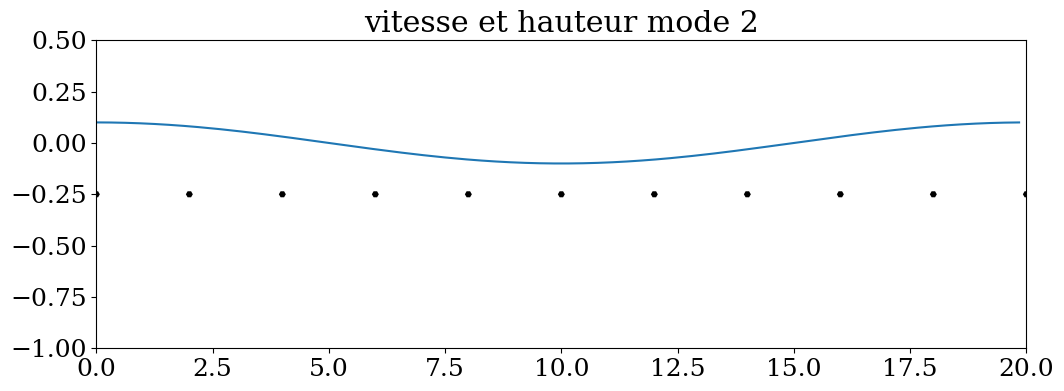
rc('animation', html='jshtml')
anim
Loading...
# ondes progressive et régressive
def hkp(k,x,t):
    global c0,L
    return 0.5*np.cos(k*np.pi*(x-c0*t)/L)
def hkm(k,x,t):
    global c0,L
    return 0.5*np.cos(k*np.pi*(x+c0*t)/L)
mode = 5
t0 = 2*L/(mode*c0)/4
plt.figure(figsize=(10,4))
plt.title("ondes progressives mode={}".format(mode))
plt.xlabel('x')
plt.ylabel('h(x,t)')
plt.plot(X,a0*hk(mode,X,t0),label="h")
plt.plot(X,a0*hkp(mode,X,t0),label="h+")
plt.plot(X,a0*hkm(mode,X,t0),label="h-")
plt.legend();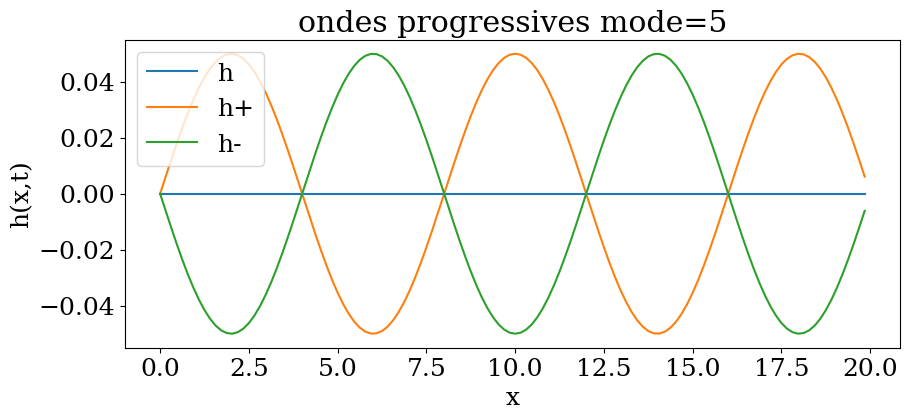
Animation
periode=2*L/(mode*c0)
t=np.linspace(0,2*periode,41)
fig = plt.figure(figsize=(10,4))
ax  = plt.axes()
line1, = ax.plot([], [],linewidth=2,label="h+")
line2, = ax.plot([], [],linewidth=2,label="h-")
plt.axis((0,L,-0.5,0.25))
plt.title("ondes progressives mode={}".format(mode))
plt.xlabel('x')
plt.ylabel('h(x,t)')
plt.legend()
def plot_mode(t):
    Y1 = a0*hkp(mode,X,t)
    line1.set_data(X,Y1)
    Y2 = a0*hkm(mode,X,t)
    line2.set_data(X,Y2)
    return
anim=animation.FuncAnimation(fig, plot_mode, frames=t)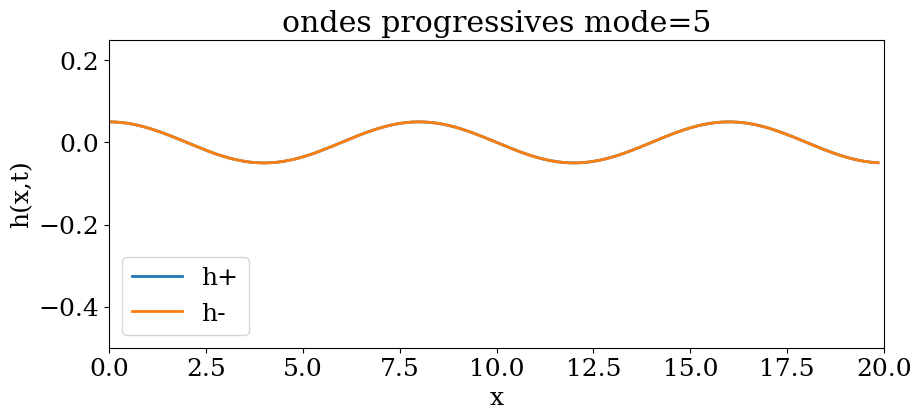
rc('animation', html='jshtml')
anim
Loading...
combinaison d’ondes stationnaires
mode = 12
combi = lambda x,t : (-hk(mode-1,x,t)+hk(mode+1,x,t))*a0
onde1 = lambda x,t : (-hk(mode-1,x,t))*a0
onde2 = lambda x,t : ( hk(mode+1,x,t))*a0
plt.figure(figsize=(12,4))
plt.plot(X,combi(X,0),label="h (x,t)")
plt.plot(X,onde1(X,0),'--',label="h1(x,t)")
plt.plot(X,onde2(X,0),'-.',label="h2(x,t)")
plt.plot(X,np.zeros(X.size),'-k',lw=2)
plt.legend()
plt.title("combinaison d'ondes")
plt.xlabel('x')
plt.ylabel('h');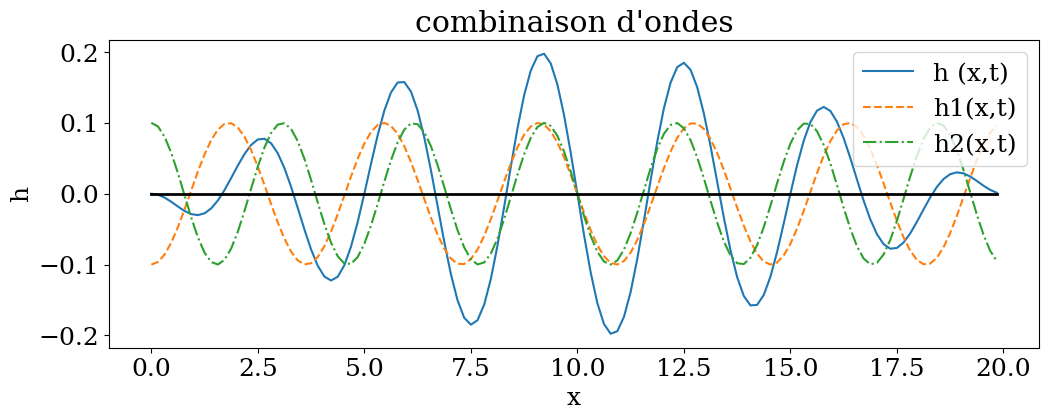
animation
# solution générale: combinaison de solutions elemetaires
periode=2*L/(mode*c0)
t=np.linspace(0,4*periode,80)
fig = plt.figure(figsize=(10,4))
ax  = plt.axes()
line, = ax.plot([], [],linewidth=2)
line1, = ax.plot([], [],'--')
line2, = ax.plot([], [],'-.')

plt.axis((0,L,-0.3,0.3))
plt.title("combinaison d'ondes de surface")
plt.xlabel('x')
plt.ylabel('h(x,t)')
def plot_mode(t):
    Y = combi(X,t)
    line.set_data(X,Y)
    Y1 = onde1(X,t)
    line1.set_data(X,Y1)
    Y2 = onde2(X,t)
    line2.set_data(X,Y2)
anim=animation.FuncAnimation(fig, plot_mode, frames=t)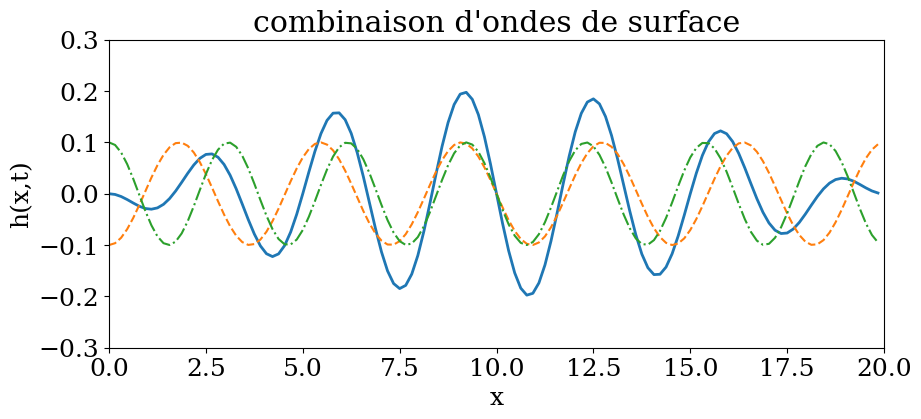
rc('animation', html='jshtml')
anim
Loading...
cas générale: décomposition en série
# perturbation initiale
hp=lambda x:-3*a0*np.exp(-(x-L/2)**2/1**2)
plt.figure(figsize=(12,4))
plt.plot(X,hp(X),label="h(x,0)")
plt.plot(X,np.zeros(X.size),'-k',lw=2)
plt.axis((0,L,-0.5,0.5))
plt.legend()
plt.title("perturbation de surface")
plt.xlabel('x')
plt.ylabel('h');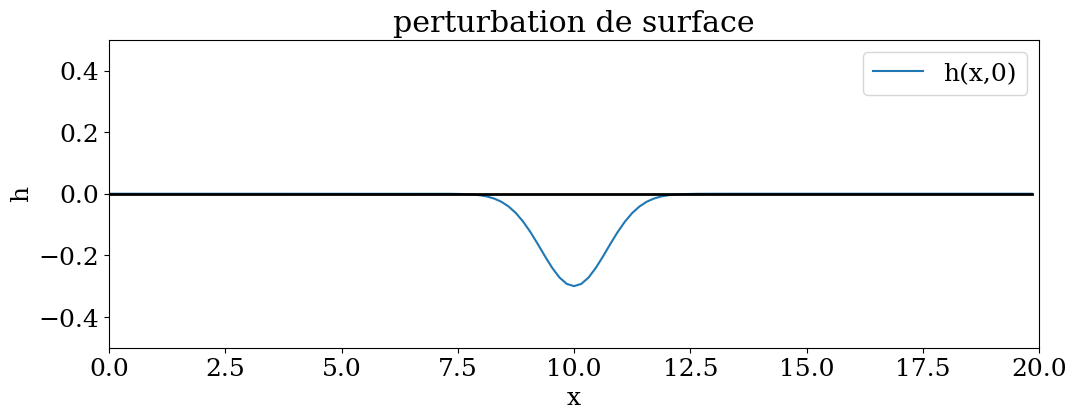
%activity /usr/local/commun/ACTIVITY/MGC3062L/questionPerturbationError in calling magic 'activity' on line:
[Errno 2] No such file or directory: '/usr/local/commun/ACTIVITY/MGC3062L/questionPerturbation'
args: ['/usr/local/commun/ACTIVITY/MGC3062L/questionPerturbation']
kwargs: {}
Traceback (most recent call last):
File "/home/buffat/venvs/jupyter/lib/python3.10/site-packages/metakernel/magic.py", line 96, in call_magic
func(*args, **kwargs)
File "/home/buffat/venvs/jupyter/lib/python3.10/site-packages/metakernel/magics/activity_magic.py", line 265, in line_activity
activity.load(filename)
File "/home/buffat/venvs/jupyter/lib/python3.10/site-packages/metakernel/magics/activity_magic.py", line 31, in load
with open(self.filename) as fp:
FileNotFoundError: [Errno 2] No such file or directory: '/usr/local/commun/ACTIVITY/MGC3062L/questionPerturbation'
%activity FILENAME - run a widget-based activity
(poll, classroom response, clicker-like activity)
This magic will load the JSON in the filename.
Examples:
%activity /home/teacher/activity1
%activity /home/teacher/activity1 new
%activity /home/teacher/activity1 edit
décomposition en série de Fourier
# calcul FFT de la CI x exp(alpha*X)
from scipy.fftpack import fft, ifft, rfft
HP  = hp(X)
# attention FFT sur un domaine double
HPF = np.zeros(2*Np)
HPF[:Np]= HP[:]
HPF[Np:]= HP[:]
HPS=fft(HPF)
# reconstruction avec nmode
nmode=16
HP1 = np.ones(Np)*HPS[0].real/(2*Np)
for k in range(2,2*nmode,2):
HP1 += HPS[k].real*hk(k,X,0)/Np
print("amplitude solution=",np.min(HP1),np.max(HP1))amplitude solution= -0.2998320170193419 0.00010105515111780661
plt.figure(figsize=(12,4))
plt.plot(X,HP1,label="h(x,0)")
plt.plot(X,np.zeros(X.size),'-k',lw=2)
plt.axis((0,L,-0.5,0.5))
plt.legend()
plt.title("reconstruction perturbation de surface")
plt.xlabel('x')
plt.ylabel('h');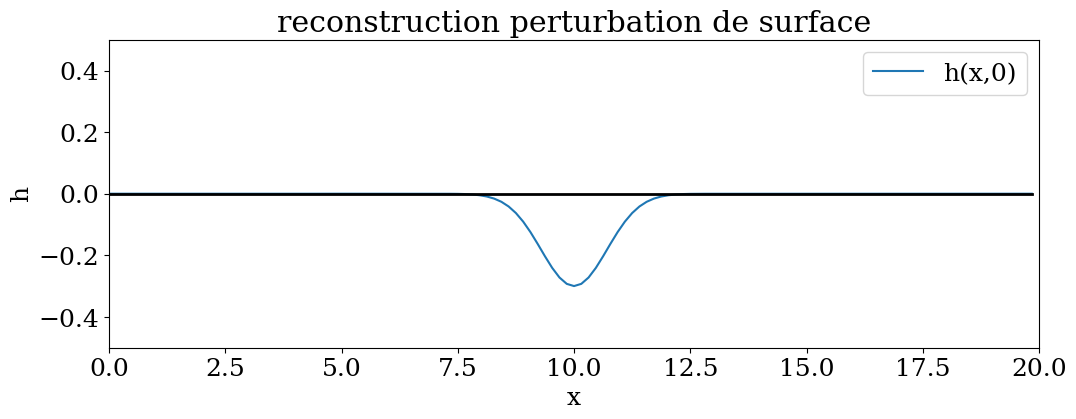
# evolution en temps
def solh(x,t):
    sol1 = np.ones(Np)*HPS[0].real/(2*Np)
    for k in range(2,2*nmode,2):
             sol1 += (HPS[k].real/Np)*hk(k,x,t)
return sol1Animation
# animation
periode=2*L/(mode*c0)
t=np.linspace(0,5*periode,40)
fig = plt.figure(figsize=(10,4))
ax  = plt.axes()
line, = ax.plot([], [],linewidth=2)
plt.axis((0,L,-0.5,0.5))
plt.title("perturbation de la surface")
plt.xlabel('x')
plt.ylabel('h(x,t)')
def plot_mode(t):
    line.set_data(X,solh(X,t))

anim=animation.FuncAnimation(fig, plot_mode, frames=t)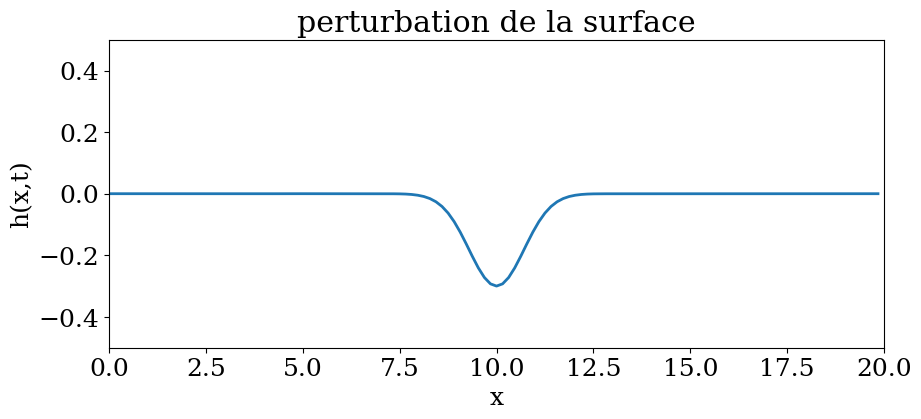
rc('animation', html='jshtml')
anim
Loading...
# loi de célérité
def c0d(k):
    return c0*(1-0.02*k)
solution élémentaire
# solution elemntaire
def hkd(k,x,t):
return np.cos(k*np.pi*x/L)*np.cos(k*np.pi*c0d(k)*t/L)Animation
# solution élémentaire animation
mode=4
periode=2*L/(mode*c0)
t=np.linspace(0,2*periode,20)
fig = plt.figure(figsize=(10,4))
ax  = plt.axes()
line, = ax.plot([], [],linewidth=2)
plt.axis((0,L,-0.5,0.5))
plt.title("solution elementaire mode={}".format(mode))
plt.xlabel('x')
plt.ylabel('h(x,t)')
def plot_mode(t):
    line.set_data(X,a0*hkd(mode,X,t))

anim=animation.FuncAnimation(fig, plot_mode, frames=t)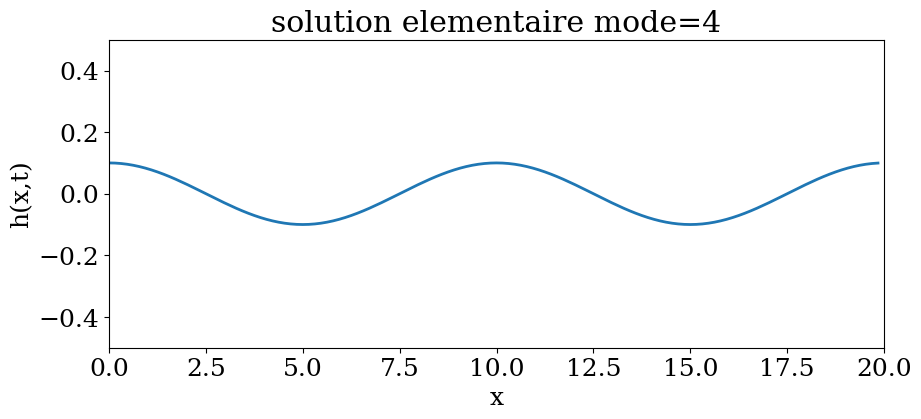
rc('animation', html='jshtml')
anim
Loading...
combinaison d’ondes stationnaires
mode = 12
combi = lambda x,t : (-hk(mode-1,x,t)+hk(mode+1,x,t))*a0animation
# combinaison d'ondes: somme d'ondes
periode=2*L/(mode*c0)
t=np.linspace(0,4*periode,41)
fig = plt.figure(figsize=(10,4))
ax  = plt.axes()
line, = ax.plot([], [],linewidth=2)
plt.axis((0,L,-0.5,0.5))
plt.title("combinaision de modes (cas dispersif)")
plt.xlabel('x')
plt.ylabel('h(x,t)')
def plot_mode(t):
    line.set_data(X,combi(X,t))

anim=animation.FuncAnimation(fig, plot_mode, frames=t)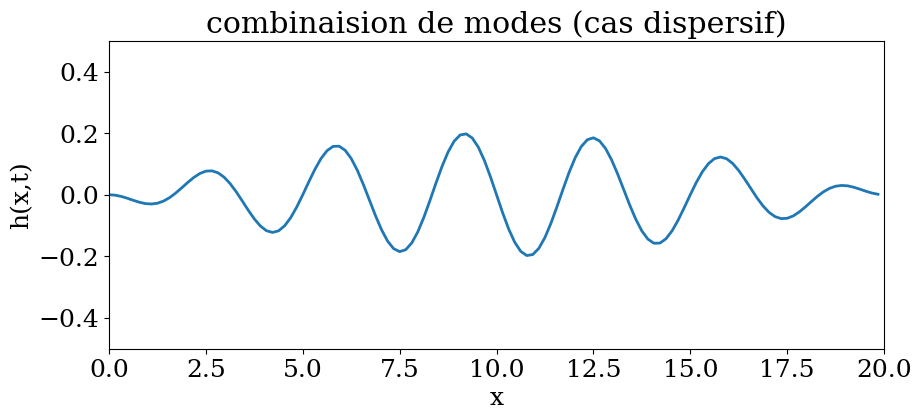
rc('animation', html='jshtml')
anim
Loading...
cas général: décomposition en serie
# evolution en temps
def solhd(x,t):
    sol1 = np.ones(Np)*HPS[0].real/(2*Np)
    for k in range(2,2*nmode,2):
             sol1 += (HPS[k].real/Np)*hkd(k,x,t)
    return sol1
plt.figure(figsize=(12,4))
plt.plot(X,solhd(X,0),label="h(x,0)")
plt.plot(X,np.zeros(X.size),'-k',lw=2)
plt.axis((0,L,-0.5,0.5))
plt.legend()
plt.title("perturbation de surface (cas dispersif)")
plt.xlabel('x')
plt.ylabel('h');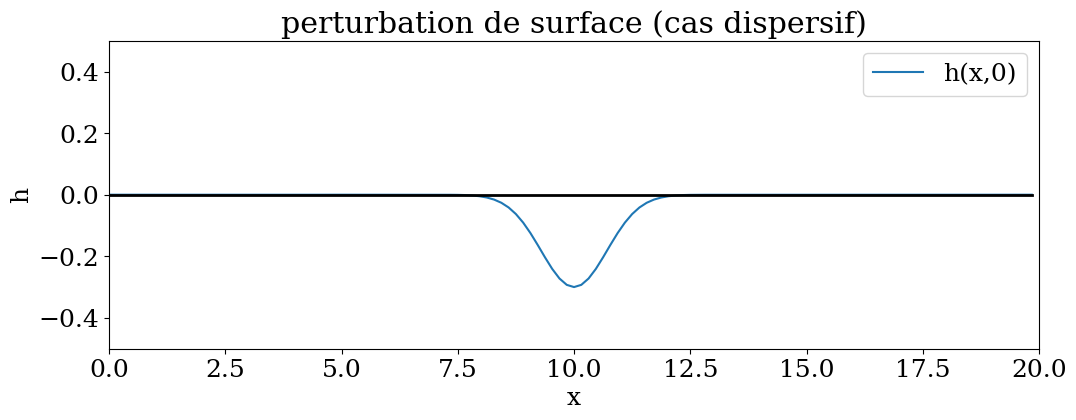
#%activity /usr/local/commun/ACTIVITY/MGC3062L/questionDispersionanimation
# animation
periode=2*L/(mode*c0)
t=np.linspace(0,10*periode,101)
fig = plt.figure(figsize=(10,4))
ax  = plt.axes()
line, = ax.plot([], [],linewidth=2)
plt.axis((0,L,-0.5,0.5))
plt.title("perturbation (cas dispersif)")
plt.xlabel('x')
plt.ylabel('h(x,t)')
def plot_mode(t):
    line.set_data(X,solhd(X,t))

anim=animation.FuncAnimation(fig, plot_mode, frames=t)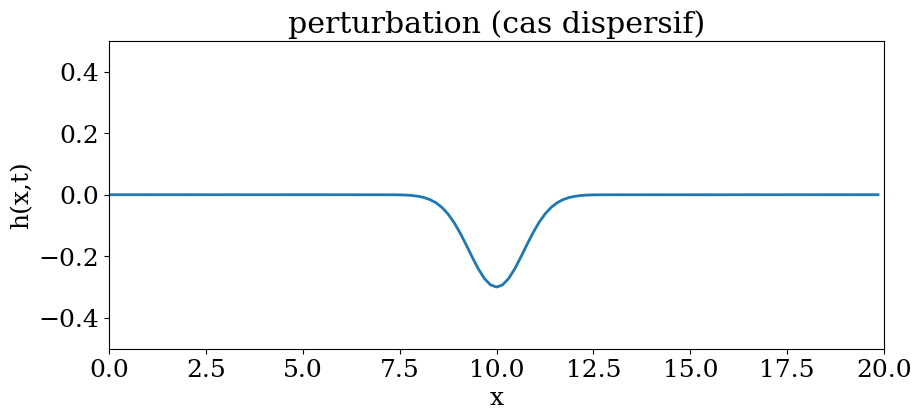
rc('animation', html='jshtml')
anim
Loading...