Free-transport dynamics with boundary effects

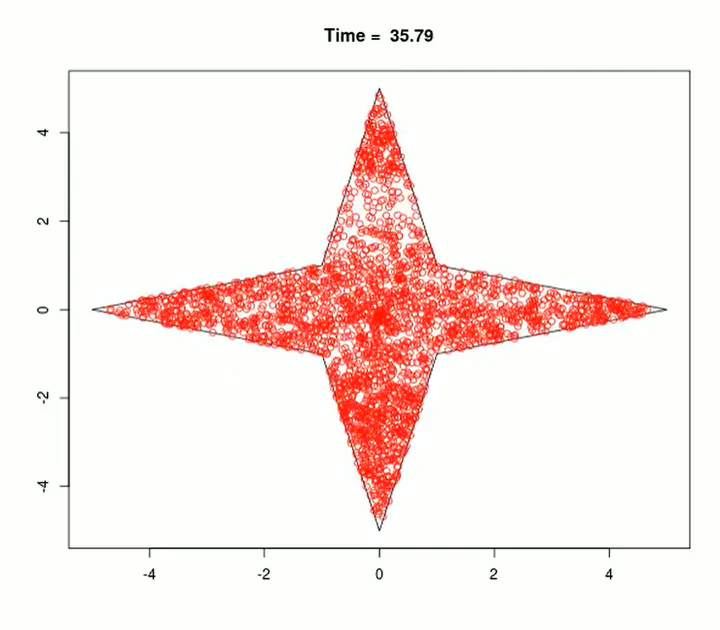 Image credit:
This page presents some simulations of the free-transport dynamics explored in this article as well as in this paper.
1 particle dynamics: diffuse and specular reflection
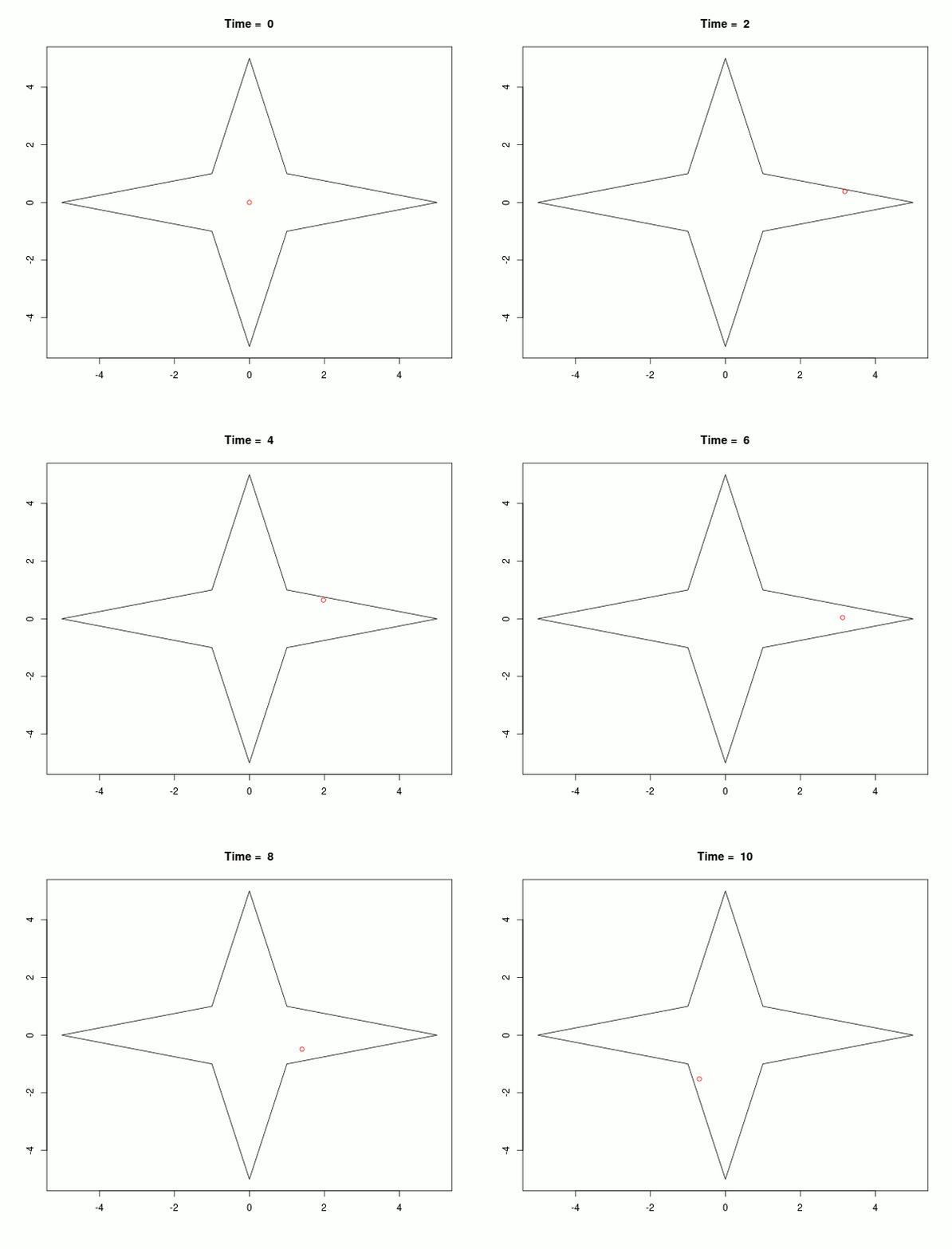
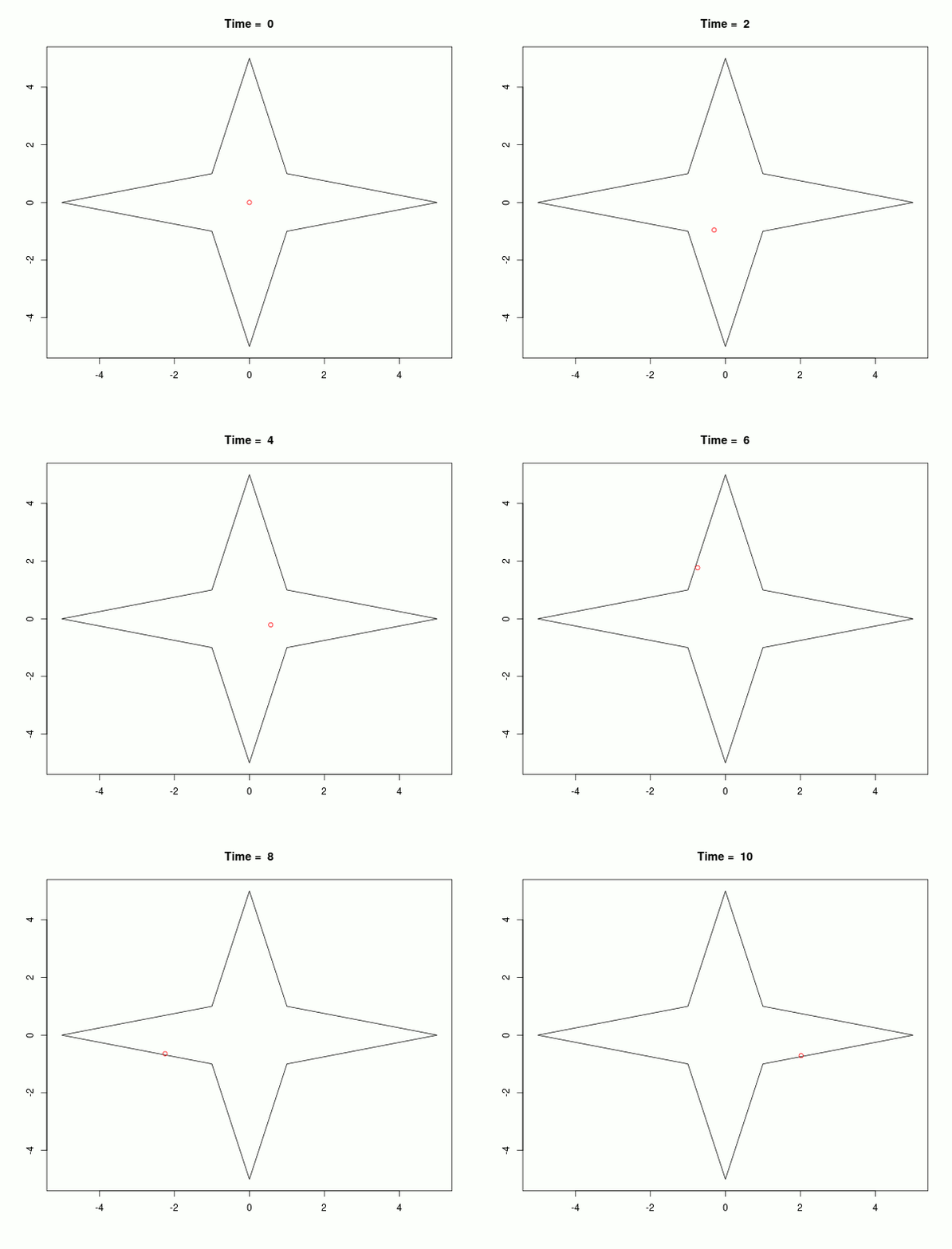
Here is a video of a particle following the free-transport equation in a star-shaped domain. The particle evolves with no constraint, following its velocity, until it hits the boundary. There, it is reflected either specularly, which means that the norm of the velocity remains unchanged and the direction of the new velocity is deterministic, or in a diffuse manner, in which case the new direction is random as well as the new speed. We call $\alpha$ the parameter playing a role in the reflection: for $\alpha = 0$ the reflection is specular, for $\alpha = 1$ the reflection is diffuse, and for $\alpha$ in $(0,1)$ a diffuse reflection occurs with probability $\alpha$ at every collision with the boundary. Here is a simulation of a particle in a star-shaped domain, with $\alpha = 1$ (left) and $\alpha = 0$ (right). Note how the speed varies on the first image, while it remains constant on the second one.
| $\alpha = 1$: diffuse reflection | $\alpha = 0$: specular reflection |
|---|---|
 |
 |
Dynamics of 5000 particles
Below is a simulation of 5000 particles with $\alpha = 1$, in the unit disk and in a star-shaped domain, starting from a Dirac mass. From the theory we expect a convergence towards the uniform distribution for the space variable, which indeed seems to occur here.
| Disk | Star-shaped domain |
|---|---|
 |
 |
No mixing at the boundary -> no mixing at all !
Finally, here is a simulation, in the star-shaped domain, of the dynamics with 5000 particles in the case $\alpha = 0$. We consider an initial distribution uniform on the unit sphere rather than a Dirac mass, since in this case, we would only see one particle for the whole simulation. As one can see below, it seems that there is no long-term convergence in this case.